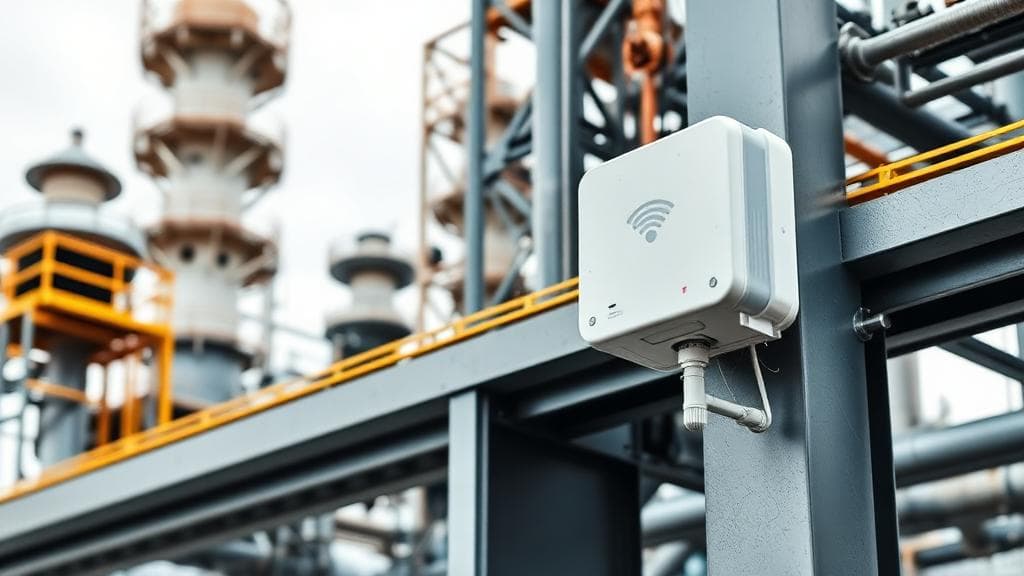
Large refineries and chemical plants stretch across tank farms, process units, loading racks, and laydown yards. During day-to-day operations—and especially during turnarounds—you need high-throughput, low-latency connectivity for thousands of contractors, digital work packs, inspection video, condition monitoring, and mobile tools. Wi-Fi 7 (802.11be) finally brings outdoor-ready capabilities that matter on the deck plates:
- Multi-Link Operation (MLO): Clients can use 5 GHz and 6 GHz together for higher throughput and more consistent latency—useful when RF conditions shift around steel.
- Up to 320 MHz channels + 4096-QAM: Big headroom for dense contractor camps, AR/remote expert video, and high-rate cameras.
- 6 GHz with AFC (Automated Frequency Coordination): In regions where standard-power outdoor 6 GHz is permitted via AFC, you can safely run high-power outdoor links without stepping on incumbents.
- Better spectral efficiency: Keeps sessions moving even when channels are partially occupied by interference.
Vendor-agnostic architecture options
Clover IQ designs and supports multi-vendor environments. We'll help you choose what fits—not force a stack.
Option A — All-Wi-Fi 7 outdoor fabric
- Where it shines: Contractor villages, laydown yards, warehouses, parking, canteens, non-classified areas.
- Pros: Lowest cost/bit; broad device compatibility; easy to scale with temporary mesh for TA.
Option B — Hybrid: Wi-Fi 7 + Private LTE/5G
- Where it shines: Plants needing voice/PTT mobility at the edge, AGVs/forklifts, roaming tools in canyons of metal.
- Pros: SIM-based mobility and QoS for critical flows, plus Wi-Fi 7 for high-throughput apps and cameras.
Option C — TA overlay (temporary)
- Where it shines: Rapid augmentation during turnarounds.
- Pros: Pre-staged Wi-Fi 7 mesh nodes, trailer-based IDFs, and battery-backed options slash setup time and recurring rentals.
Option D — Hazardous-area builds
- Where it shines: Class I/Division 2 or ATEX/IECEx Zone 2 perimeters and access routes.
- Pros: Rated enclosures, intrinsically safe antennas, and purge/pressurization kits extend coverage safely.
ROI by the next turnaround: an honest model
Capex (one-time) — mid-size site:
- 120 outdoor Wi-Fi 7 APs @ $2,800 → $336,000
- 30 hazardous-area enclosures @ $2,500 → $75,000
- 12 IDFs with 48-port PoE++ @ $5,500 → $66,000
- UPS & lightning/SPD → $24,000
- Fiber/copper/conduit → $180,000
- Controllers/licensing/NMS → $120,000
- Design/survey/PM → $110,000
- Installation labor → $180,000
- Total Capex: ~$1.091M
Benefits within one turnaround cycle:
- Digital permits & work-packs time savings
- Eliminated temporary network rentals (COWs, pop-up Wi-Fi): $180,000 per event
- Avoided cabling/scaffolding for temp cameras: $72,000
- Cellular offload: $72,000
- Remote expert / fewer site fly-outs: $80,000
Conservative benefits: ~$729,000/year TA-intensive benefits: ~$1,379,000/year
Practical tips for petrochemical sites
- Design for capacity, not just coverage. Turnarounds spike to thousands of clients per zone.
- Treat 6 GHz as premium lanes. Use AFC-enabled outdoor radios where permitted.
- Engineer for weather and corrosion. NEMA 4X/IP66/67 enclosures, stainless mounts, UV-rated cabling.
- Protect the plant first. Follow electrical classification rules; bond every mast; use surge protection.
- Onboard at scale. Certificate-based onboarding for staff; individualized PSKs for contractors.
- Instrument the network. Per-client telemetry, RF analytics, and simple SLOs.
A 90-day path to results
Days 0–15
Business & RF discovery, hazard-class walk-down, spectrum samples.
Days 16–45
Low-risk pilot (8–12 APs, contractor onboarding, 15–20 cameras).
Days 46–75
Expand design, finalize BOM, security patterns, TA overlay plan.
Days 76–90
Implementation in priority zones. Hand-off runbooks and SLO dashboard.
How Clover IQ helps
- Outdoor Wi-Fi 7 Readiness Assessment (no cost): 60–90-minute session + light RF pre-survey.
- Design Workshop: Vendor-agnostic architecture with Wi-Fi 7 and (optionally) private LTE/5G.
- Pilot Kit: Pre-staged gear for a 90-day field trial.
- ROI Model: We replace the example math with your data and deliver a CFO-ready calculation.
- Build & Run: Turnkey deployment and managed service through the critical TA window.