All
Where Private 5G Doesn't Work (and What to Do Instead)
Private 5G is powerful, but not universal. Learn when to use Wi-Fi, LMR, satellite, or hybrid architectures instead.
Read article →Oil & gas
25 min read · September 19, 2025
A comprehensive blueprint for leaders planning a Private 5G program across O&G segments
Clover IQ
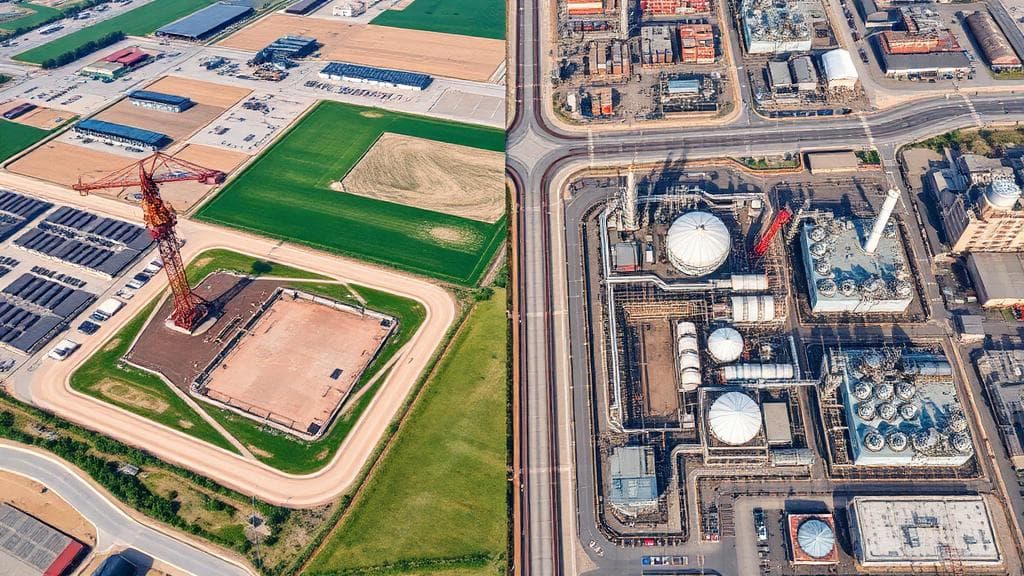
Oil & Gas operations—upstream, midstream, downstream—demand reliable, secure, low-latency connectivity across harsh, hazardous, and highly dynamic environments. Private 5G has matured into an operational fabric capable of supporting connected worker safety, digital permits, mobile video, telemetry, and autonomous workflows at industrial scale.
This white paper provides a vendor-agnostic blueprint for leaders planning a Private 5G program. It covers Greenfield vs. Brownfield realities by segment, a step-by-step deployment process, spectrum options in the U.S. and Canada, fiber vs. microwave backhaul economics, device ecosystem and certification, success metrics, risk register, and a pragmatic TCO scaffold.
Greenfield: Design in safety & RF from day zero—place masts with safe-power conduits; pre-stage microwave to core; specify C1D1/Zone 1 devices in the instrument index. Coverage strategy: perimeter macro + sectorized yards; small cells for rig floors, pipe decks, well pads.
Brownfield: Align radio install with turnarounds; treat each unit like a mini-project with confined-space and hot-work permissions. Coexistence: LMR/PTT interop, Wi-Fi offload for noncritical; RF plan for heavy steel and flameproof housings.
Greenfield: Linear coverage: macro along ROW with repeaters at elevation; small cells at stations and terminals. Backhaul: microwave between stations; fiber where highway/rail corridors ease aerial placement.
Brownfield: No-dig first—avoid trenching across right-of-way; leverage microwave + existing fiber stubs. Validate handover for patrol trucks and yard vehicles.
Greenfield: Bake-in conduits—pre-wire safe power and fiber; specify RF-friendly building materials; centralized on-prem core with redundant UPF. Dense small-cell topologies: coverage for vessels, exchangers, racks.
Brownfield: Metallic maze—multi-path and shadowing demand tight cell planning; layer with existing high-density Wi-Fi; define mobility domains to prevent ping-pong. Align RF work with management of change (MoC) and EHS procedures.
Inputs: site drawings, hazardous zoning maps, asset hierarchy, EHS constraints, current connectivity inventory. Activities: RF walkdowns, backhaul pathing, power audit, grounding plans, safety method statements.
Define SLOs per use case: PTT setup <150 ms; C1D1 video 2–6 Mbps uplink sustained; work-permit cycle time reduction; lone-worker SOS delivery <3 s.
U.S.: start on CBRS GAA; add PALs where interference risk or capacity congestion appears. Canada: map NCL local areas; plan capacity within local allocations.
RAN (macro + small), packet core (on-prem SA), SAS, device mgmt (eSIM/IMEI), security (Zero Trust), backhaul (fiber/microwave), RTLS, PTT/MCX.
Link budgets, sectorization, handover plans, interference modeling; antenna placements with C1D constraints.
IT/OT identity, network segmentation, Zero Trust, NAC for OT, MFA for admin.
Coverage %, RSRP/RSRQ/SINR thresholds; uplink throughput per camera; HO times; PTT MOS; E2E latency.
24×7 monitoring; RF optimization; SIM/device lifecycle; patching; vulnerability mgmt; spares & swap.
Steel, pressure, weather, and time don't read slideware. They yield to design, discipline, and data. Private 5G delivers when you build for outcomes: map the work, plan the uplink, prove the KPIs, and fund Day-2. That's the Clover IQ way—forward-leaning, vendor-agnostic, and obsessed with your business result.
Related articles
All
Private 5G is powerful, but not universal. Learn when to use Wi-Fi, LMR, satellite, or hybrid architectures instead.
Read article →Oil & gas
How MQTT messaging and private LoRa networks combine for cost-effective asset monitoring across upstream and midstream operations.
Read article →Chemical
Deployment considerations for Wi-Fi 7 in petrochemical environments — coverage, coexistence, and hazardous area constraints.
Read article →